КАТЕГОРИИ:
Архитектура-(3434)Астрономия-(809)Биология-(7483)Биотехнологии-(1457)Военное дело-(14632)Высокие технологии-(1363)География-(913)Геология-(1438)Государство-(451)Демография-(1065)Дом-(47672)Журналистика и СМИ-(912)Изобретательство-(14524)Иностранные языки-(4268)Информатика-(17799)Искусство-(1338)История-(13644)Компьютеры-(11121)Косметика-(55)Кулинария-(373)Культура-(8427)Лингвистика-(374)Литература-(1642)Маркетинг-(23702)Математика-(16968)Машиностроение-(1700)Медицина-(12668)Менеджмент-(24684)Механика-(15423)Науковедение-(506)Образование-(11852)Охрана труда-(3308)Педагогика-(5571)Полиграфия-(1312)Политика-(7869)Право-(5454)Приборостроение-(1369)Программирование-(2801)Производство-(97182)Промышленность-(8706)Психология-(18388)Религия-(3217)Связь-(10668)Сельское хозяйство-(299)Социология-(6455)Спорт-(42831)Строительство-(4793)Торговля-(5050)Транспорт-(2929)Туризм-(1568)Физика-(3942)Философия-(17015)Финансы-(26596)Химия-(22929)Экология-(12095)Экономика-(9961)Электроника-(8441)Электротехника-(4623)Энергетика-(12629)Юриспруденция-(1492)Ядерная техника-(1748)
Integrated Versus Separate International Activities
|
|
|
|
All of a company's international activities may be grouped together (e.g., international department or division) or gathered by the product, function, or geographic structure the company relies on domestically. Figure 17.1 shows simplified examples of different approaches to the placement of foreign activity within the organizational structure; most companies broadly fit one of these categories.
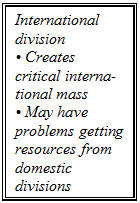 International Division The separation of international activities allows for specialized personnel to handle such diverse matters as export documentation, foreign-exchange transactions, and relations with foreign governments. By combining all international operations, the international activities constitute a large enough critical mass to wield power within the organization. When separated among product or functional units, these activities may be so small in comparison to domestic business that the firm gives little attention to their development. On the other hand, this separation may necessitate dependence of the international division on the domestic divisions for product, personnel, technology, and other resources. Since managers in the domestic divisions are evaluated against domestic performance standards, they may withhold their best resources from the international group in order to improve their own performance.
Part A of Fig. 17.1 is an example of separating international operations, as used by such firms as Campbell Soup.11 Although this structure is not popular among European multinational firms, it is very common among those based in the United States.12 One of the apparent causes for the difference is that U.S. firms are typically much more dependent on the domestic market than are European firms; therefore, the international division allows U.S. firms to gain the "critical mass" discussed above.
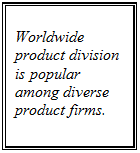 Product Division Parts B, C, and D in Fig. 17.1 are types of international operations that are integrated rather than handled separately. The product organization (B) is particularly popular among companies that operate within highly diverse product groups, especially those that have become diverse primarily through acquisitions, such as Motorola. Since the product groups may have little in common, even domestically, the groups may be highly independent of each other. Note that different subsidiaries within the same foreign country will report to different groups at headquarters.
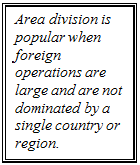 Geographic (Area) Division The geographic organization, part C in Fig. 17.1, is used primarily by firms with very large foreign operations not dominated by a single country or area. This structure is found more commonly among European MNEs, such as Nestle, than among U.S. MNEs because of the dominance of the U.S. domestic market. Recall that Nestle can use this structure because no one region dominates its operations.
Functional The functional organization, part D in Fig. 17.1, is popular among extractive companies (such as oil or bauxite extraction) because of their very homogenous products for which production and marketing methods are relatively undifferentiated from one country to another. For example, it is used by Exxon.
 Matrix Because of the problems inherent in either integrating or separating foreign operations, some firms, such as Dow Chemical, are moving toward matrix organizations, part E in Fig. 17.1. In these organizations a subsidiary reports to more than one group (product, function, or area). The theory is that, since each group shares responsibility over foreign operations, each group will depend on the others. The groups will become more interdependent, will exchange information, and will ultimately take strategic global perspectives as they seek to exchange resources with other groups. For example, product group managers must compete so that R&D personnel responsible to a functional group are assigned to the development of technologies that fall within their product domain. The same product group managers must compete as well to see that area managers put sufficient emphasis on their lines. Not only are product groups competing, the functional and geographic areas also must strive to draw upon resources held by others in the matrix.
Although a matrix form requires that all major perspectives be represented in strategic decision making, this form of organization is not without 'drawbacks. One of the problems is that groups and coalitions inevitably compete for scarce resources, and a management decision must be made above the group level on how to allocate the resources when lower-level managers fail to reach an agreement. Such elements as faith in a specific executive or business group may result in more decisions being made in their favor.13 As others in the organization see this occurring, they may perceive that the locus of relative power lies with a certain individual or group, which may lead managers in turn to divert most of their energies toward the activities that are perceived as most likely to be accepted, thus perpetuating the difference in relative power. This may not represent the areas that would be the firm's best strategic choices on a global basis. Consequently, some of the advantages sought in a matrix organization may be diminished because of these interpersonal relationships. A number of alternatives may help to alleviate this problem, including the transfer of individuals among groups and the development of additional reporting and control systems reflecting each of the three groups (product, function, and area) on a global basis. However, these alternatives are not without costs.
|
|
|
|
|
Дата добавления: 2014-11-29; Просмотров: 505; Нарушение авторских прав?; Мы поможем в написании вашей работы!